
Car hire deposit and excess in Italy
Across the 9335 offers from 156 places checked on October 20, 2026, the median deposit is €500 and the median excess €1650. 35% of offers ask for €300 at most. The deposit is usually not a payment but a hold on your credit card, released after you return the car; the excess is the part of any damage or theft that you pay yourself, and it drops to zero with optional full cover (median €16 per day).
Official sources read on October 19, 2026.
Find a rental carDeposit and excess: the difference
The deposit is a guarantee: the rental company holds an amount on the main driver's card at pick-up and releases it at return if there is no damage, no fines and no fuel to pay for. The excess, on the other hand, is a cap: it is the most you pay if the car is damaged or stolen, even when the damage costs more.
The two amounts are often close, because the deposit is there precisely to cover the excess. Third-party liability is always included in the price; the excess only concerns damage to the rental car and theft.
- The deposit is normally an authorisation (a hold) sent to the cardholder's bank, not an immediate payment; the rental company sets the amount, which is usually equal to the excess and rises with the car category.Source: ECC France (Centre Européen des Consommateurs France, ECC-Net) – "Renting a car in Europe"
- The European Consumer Centre Italy cites deposits from about €200 to over €1,500, depending on the car category and the cover purchased, and advises checking your card limit before you travel.Source: ECC-Net Italia (Centro Europeo Consumatori Italia) – "Noleggio"
- The excess is the part of the loss borne by the insured person, as set by the contract.Source: IVASS – "Le guide assicurative in parole semplici, Volume 3: La responsabilità civile auto"
- Third-party liability insurance is compulsory and included in the rental price throughout the EU; other cover (damage to the car, theft, driver injury) is optional.Source: Your Europe (European Union) – "Hiring and driving a car in another EU country"
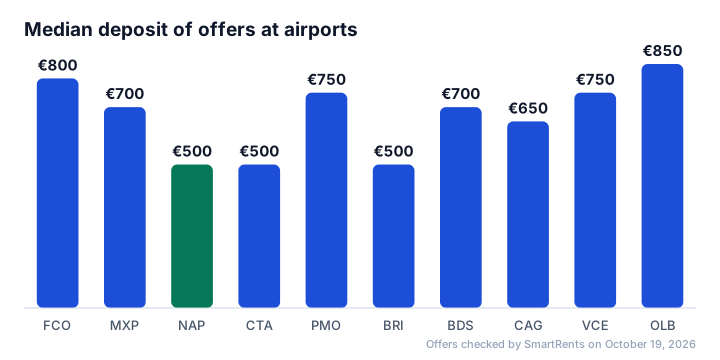
How much is held: deposits in the most searched places
The figures come from the offers we check every day in the places that have their own page (9335 offers on October 20, 2026). The median deposit is €500; 35% of offers ask for €300 at most. At airports the deposit varies a lot from one desk to another: look at it alongside the price, not afterwards.
When the deposit is released
The hold is removed by the bank that issued the card, when it receives the final amount (even zero) from the rental company. So after you return the car, the timing depends on two steps: how long the rental company takes to close the contract and how long the bank takes to free up the card limit.
- When the amount of a card payment is not known in advance, the bank may block funds only if the cardholder has agreed to a specific amount, and must release them without delay as soon as it receives the final amount.Source: Normattiva – D.Lgs. 27 gennaio 2010, n. 11, art. 12-bis "Operazioni di pagamento il cui importo non sia noto in anticipo"
- The AGCM, Italy's competition and consumer authority, found it unjustified to release the deposit days after the car was returned, because it increased the pressure on customers to buy extra cover.Source: AGCM – decision PS9879 (adunanza 19 Jul 2017)
- After returning the car, the European Consumer Centre advises asking for the pre-authorisation to be cancelled and checking that it has been: unexpected charges (damage, fine-handling fees, fuel) can arrive even months later.Source: ECC-Net Italia (Centro Europeo Consumatori Italia) – "Noleggio"
Reducing the excess to zero: rental company cover or separate reimbursement
There are two routes. The rental company's full cover reduces the excess to zero (or nearly) and often lowers the deposit too: in our offers it can be added on the partner's site in 100% of cases, at a median of €16 per day. A reimbursement policy bought separately usually costs less, but the rental company is not part of it: the deposit stays blocked and, if there is damage, you pay first and then claim the money back.
Either way, read the exclusions: tyres, glass, underbody, roof, keys and wrong fuel are often not covered.
- Super CDW / SLDW is the rental company's option that reduces the excess or brings it to zero.Source: ECC France (Centre Européen des Consommateurs France, ECC-Net) – "Renting a car in Europe"
- With the rental company's cover the deposit can go down or disappear (a small amount may remain for fines); it usually costs more.Source: ECC-Net Malta – leaflet "Renting a Vehicle in Europe"
- With cover bought on a reservation site, the rental company still asks for the deposit and charges any damage to your card; you then claim the money back from the platform's insurer.Source: ECC-Net Malta – leaflet "Are you planning to rent a car in Europe?"
- Cover sold by intermediaries usually reimburses the excess paid to the rental company, but this is not a rule: check it in writing.Source: ECC-Net Italia (Centro Europeo Consumatori Italia) – "Noleggio"
- Zero-excess options often have exclusions worth checking: tyres, glass, underbody, roof, keys, wrong fuel, the obligation to file a police report, alcohol.Source: ECC France (Centre Européen des Consommateurs France, ECC-Net) – "Renting a car in Europe"
- Before buying more cover, check whether your credit card already covers the rental excess.Source: ECC France (Centre Européen des Consommateurs France, ECC-Net) – "Renting a car in Europe"
At pick-up and return: the evidence that protects you
Almost every damage dispute is won or lost on the evidence from that moment. Have every scratch marked on the form before you drive off, photograph and film the car with the date and number plate visible and, at return, have the car inspected and the report signed.
- At pick-up, the staff member must note on the form any damage or missing items already present.Source: ECC-Net Italia (Centro Europeo Consumatori Italia) – "Noleggio"
- Detailed photos and videos (outside, inside and, if possible, underbody) with the date, time and number plate visible.Source: ECC-Net Italia (Centro Europeo Consumatori Italia) – "Noleggio"
- At return, the car should be inspected straight away by the staff member and the inspection countersigned, to avoid later charges to your card.Source: ECC-Net Italia (Centro Europeo Consumatori Italia) – "Noleggio"
- The rental company must show you the reasons for and evidence of any damage before charging for it, with the repair invoice or a fair estimate.Source: European Commission – press release IP/17/86 "Car rental companies improve treatment of consumers, thanks to EU-wide enforcement"
- “Sign or you don't leave” is always unlawful: if necessary, call the police and keep a copy of everything.Source: ECC-Net Italia – leaflet "Il noleggio dell'auto"
If you are charged for damage you dispute
Write to the rental company straight away with your evidence (photos, report); then, if it does not reply, contact the European Consumer Centre. For a card charge you can also go to your bank: the law provides for a refund in some cases, and the card networks have their own “chargeback”, which however is not a right.
- For a payment authorised without a specific amount, you can get a refund if the amount exceeds what you could reasonably have expected.Source: Normattiva – D.Lgs. 11/2010, art. 13 "Rimborsi per operazioni di pagamento autorizzate disposte dal beneficiario o per il suo tramite"
- The refund request must be made within 8 weeks of the charge; the bank must refund or give reasons for refusing within 10 working days.Source: Normattiva – D.Lgs. 11/2010, art. 14 "Richieste di rimborso per operazioni di pagamento autorizzate disposte dal beneficiario o per il suo tramite"
- Chargeback is a protection offered by the card networks, not a legal right; it usually has to be requested within 120 days of the charge.Source: Banca d'Italia – "Domande e risposte sui pagamenti per gli acquisti on line di beni o servizi"
- The European Consumer Centre Italy offers free help with complaints and disputes with rental companies from other EU countries.Source: ECC-Net Italia – leaflet "Il noleggio dell'auto"
- The European ODR (online dispute resolution) platform has not existed since 20 July 2025: the Commission now points to the list of national dispute resolution bodies.Source: European Commission – Consumer Redress in the EU, "Site relocation" notice (former ODR platform address)
What the rental company must tell you before you book
- Before a distance contract (such as an online reservation), any deposits and other financial guarantees required must be stated clearly.Source: Normattiva – Codice del Consumo (D.Lgs. 206/2005), art. 49 "Obblighi di informazione nei contratti a distanza..."
- Hiding relevant information, or giving it unclearly or late (for example only at the desk), is a misleading omission if it can change the decision.Source: Normattiva – Codice del Consumo (D.Lgs. 206/2005), art. 22 "Omissioni ingannevoli"
- The AGCM has penalised rental companies that used a high deposit, disclosed only at the desk, to push extra cover.Source: AGCM – press release PS9879/PS10620 (two rental companies fined for deposit-based pressure)
- Hiring a car for specific dates does not come with the 14-day right of withdrawal.Source: Normattiva – Codice del Consumo (D.Lgs. 206/2005), art. 59 "Eccezioni al diritto di recesso"
Frequently asked questions
How much is the deposit to hire a car in Italy?
It depends on the offer: across the 9335 offers checked on October 20, 2026 the median is €500, 35% ask for €300 at most. It rises with the car category and falls with the rental company's full cover.
Is the deposit charged or only held?
With a credit card it is usually only held (pre-authorisation) and released after you return the car. With a debit card, when accepted, it is often charged and then refunded.
How long does it take for the deposit to be released?
The bank must release it as soon as it receives the final amount from the rental company; the actual timing depends on when the rental company closes the contract and on the bank. If it is still blocked after you return the car, ask in writing for the pre-authorisation to be cancelled.
How do you hire a car with no excess?
By adding the rental company's full cover (median €16 per day in our offers), which reduces the excess to zero and often lowers the deposit. A reimbursement policy bought separately costs less but does not remove the deposit.
What should I do if I'm blamed for damage when I return the car?
Ask for the evidence and the repair invoice or estimate, show your photos and the pick-up report, and dispute it in writing; for the card charge you can ask your bank for a refund within 8 weeks and get free help from the European Consumer Centre.
Other guides
- Driving licence to rent a car in Italy: when you need an International Driving Permit
- Car hire in Italy for young and new drivers (under 25)
- Car hire in Italy with a debit card: who accepts it
- Taking a hire car abroad and to Italy's small islands
- What driving in Italy costs: fuel, tolls and parking
- ZTL zones, fines and car hire in Italy: what to know before you drive
- Car hire in Italy: price, deposit and excess compared